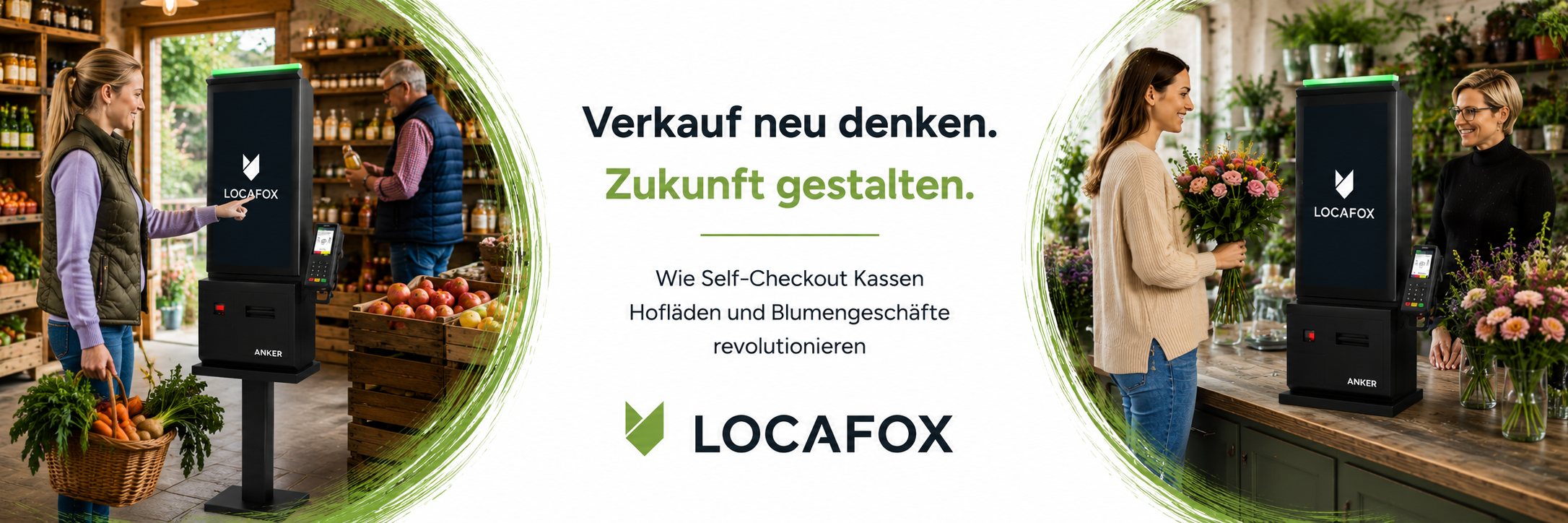
The retail industry is undergoing a transformation. Today’s customers expect flexible shopping options, personalized advice, and a modern shopping experience—yet many retailers are struggling with staff shortages and rising costs. Modern self-checkout systems offer a sustainable solution to these challenges: They ease the daily workload, create new sales opportunities, and open the door to innovative concepts for brick-and-mortar retail. Farm stands and flower shops, in particular, are impressively demonstrating how tradition and digitalization can be successfully combined.
Our simple and expandable POS system makes everyone happy: you, your customers, employees and the tax office - thanks to direct DATEV connection.
Today, customers expect more flexibility, shorter wait times, and shopping options that fit into their daily lives—regardless of traditional business hours. At the same time, many retailers face challenges of their own: rising labor costs, a shortage of skilled workers, and the desire to operate more efficiently.
While large retail chains have been relying on automation and digital processes for years, smaller businesses and direct sellers are also increasingly discovering new opportunities.
One development is of particular interest here: Self-checkout solutions.
What used to be primarily associated with supermarkets is now emerging as an interesting option for smaller retail concepts—especially in situations where personal advice remains important, but not every sale requires assistance.
Two industries illustrate particularly clearly how modern point-of-sale systems can transform the retail sector: farm stores and flower shops.
And this isn't just a theoretical concept—we see it in action in projects with our clients.
Self-checkout has long since ceased to mean simply “the customer scans the items themselves.”
Modern self-checkout registers open up new possibilities:
The goal is not to replace people—but to have them focus their time where they create the greatest value. This opens up new opportunities, especially in owner-managed retail businesses.
Of course, implementing a modern self-checkout system requires an initial investment. The technology, modifications to the sales floor, and integration into existing processes should be carefully planned. At the same time, experience shows that such investments often pay for themselves faster than expected—for example, through extended operating hours or more efficient processes.
What’s more, those who invest in digitalization today often don’t have to finance this step on their own. For direct marketers and retailers, there are now various incentive programs that support digital modernization and new sales strategies.
Local sourcing is no longer just a trend—for many customers, it’s a key selling point.
More and more consumers want to know where their products come from. They make a conscious effort to buy directly from producers, pay attention to quality, and value short supply chains.
Although this development represents a major opportunity for many farmers, many farms are under enormous time pressure. Today, farming involves not only production, but also organization, marketing, and customer contact.
This is exactly where self-checkout opens up new possibilities.
A modern farm stand allows farmers to sell their products directly—without being completely tied to traditional business hours or having to have staff on hand at all times.
With a self-checkout register, a farm store can:
The benefit for customers is obvious:
Fresh products straight from the producer—whenever it fits into your daily routine.
A good example of this is our client Markus Breil. There, the farm store was redesigned to allow customers to shop with much greater flexibility—even outside of traditional business hours. At the same time, this leaves more time for the actual work on the farm, without having to give up direct sales.
This way, the farm store becomes not just an additional sales space, but a useful complementary sales channel.
👉 Read more in the article: Self-Checkout Registers for Farm Stores – How SCO Registers Work in Practice
Direct marketers, in particular, would also be wise to look into existing funding opportunities. Many programs support investments in digital infrastructure and modern sales concepts—thereby making it easier to get started.

Customer expectations are changing in the floral industry as well: Flowers are an emotional product, and many customers want personalized advice or a bouquet arranged just for them.
But this is precisely where an economic problem often arises: While a florist invests time in providing high-quality advice, other customers with simple purchase requests wait at the register—or leave the store.
This results in a loss of revenue.
In the flower business, self-checkout does not replace personal advice. It complements it.
While employees focus on providing advice, addressing individual requests, or arranging bouquets, customers can complete their purchases on their own with a quick shopping trip.
This creates benefits for both sides:
In addition, new opportunities are emerging—such as longer operating hours or better coverage during peak times.
The flower shop remains a personal place, but at the same time is becoming more flexible.
Our client Biaca Meiser demonstrates how this works in practice. There, the combination of personalized service and self-checkout has made it possible to better cater to different customer groups: Those who want advice get it—and those who want to quickly pick up a ready-made bouquet can do so with ease.
👉 Read more in the article: Flowers for the Soul – A Flower Shop in the Age of Technology
This also illustrates that investing in modern point-of-sale technology is often worthwhile not only because of the time saved, but above all because of the additional sales opportunities and improved processes it offers.
When people talk about the digitization of retail, many think first of large chains. Yet it is smaller retailers in particular who stand to benefit—because modern point-of-sale systems make possible something that was previously almost impossible: conducting sales without relying on constant staff availability.
This opens the door to new concepts:
This isn't about replacing human connection—quite the opposite:
Digital processes create space for genuine advice, quality, and customer experience.
Our client projects demonstrate time and again that the greatest impact doesn't come from technology alone—but from how retailers refine their processes and take advantage of new opportunities.
With the right funding opportunities and a clear strategy, digitalization becomes not only technically feasible but also economically viable.

Farm stands and flower shops demonstrate how digitalization can create real added value even in small-scale retail.
Businesses that effectively integrate modern processes save time, generate additional revenue, and improve the shopping experience at the same time.
Even though getting started requires an initial investment, experience shows that well-planned self-checkout concepts can quickly pay off—especially when they result in extended operating hours and more efficient operations.
Self-checkout is not the goal here.
It is a tool that can be used to meaningfully evolve existing trading models, and that is precisely where the opportunity for the future of trading lies.
The introduction of modern point-of-sale systems and new sales concepts often raises many questions—ranging from technical implementation to financial planning. This is exactly where LocaFox can help.
Drawing on our experience with a wide variety of retail projects, we provide our clients with expert advice and support them in finding the right solutions for their specific needs. Our goal is to play an active role in shaping the future of modern retail—in a practical, forward-looking way, and always with an eye toward real-world needs.
After all, retail is constantly evolving—and we at LocaFox are evolving right along with it.