Germany is facing a major change in cash register management. On September 23, 2026, the Federal Cabinet approved the draft bill for the so-called Second Cash Register Act. This legislation is intended to introduce, for the first time, a far-reaching requirement to use electronic cash register systems. At the same time, digital receipts are set to become the standard in the future.
Our simple and expandable POS system makes everyone happy: you, your customers, employees and the tax office - thanks to direct DATEV connection.
First, it is important to note that there is still no general requirement in Germany to use an electronic cash register. Businesses are generally still permitted to use a traditional cash register, but they must comply with existing tax record-keeping and documentation requirements.
That is set to change for some companies starting in 2028. However, the legislative process has not yet been completed. The following information therefore reflects the current status of the government’s draft bill.
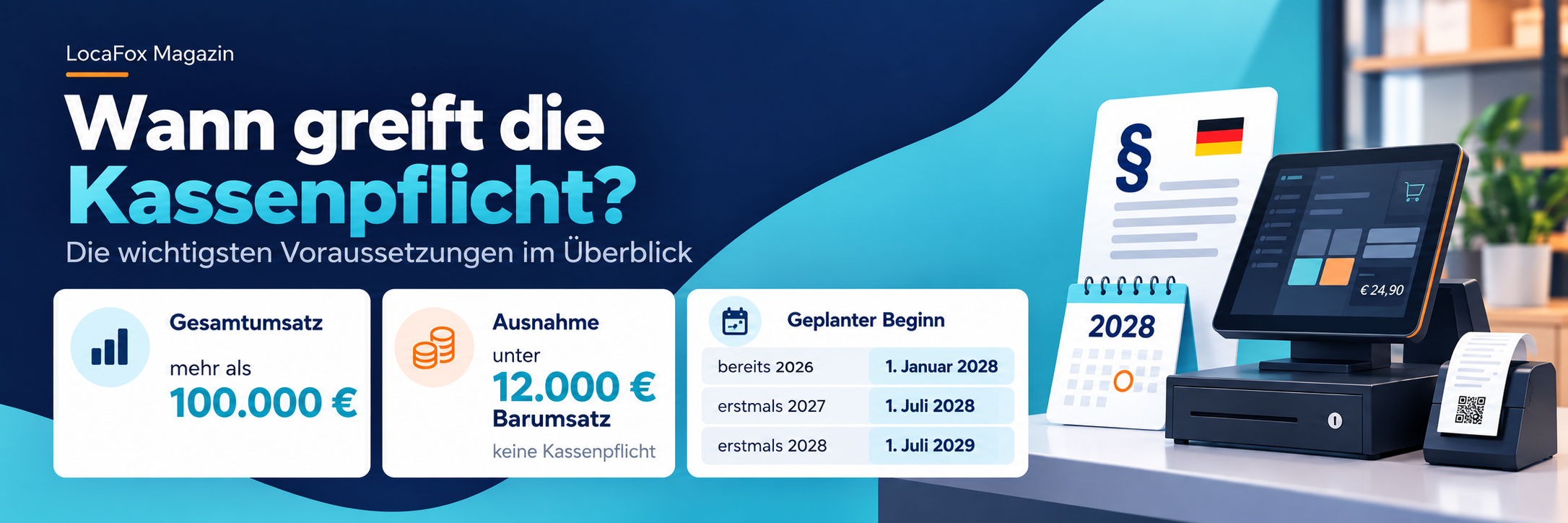
According to the current government draft, the cash register requirement would generally apply if the total revenue, as defined in Section 19(2) of the Value-Added Tax Act (UStG), exceeds 100,000 euros in a calendar year. It is important to note that this refers not only to cash or register sales, but to the company’s total revenue as defined for tax purposes.
The draft bill already provides for one important exception: Businesses that accept cash payments but have annual cash sales of less than 12,000 euros will not be subject to the new cash register requirement.
For many retailers who already use a modern electronic point-of-sale system, this is unlikely to change much at first. Anyone who uses an electronic point-of-sale system with cash register functionality must already comply with existing requirements regarding the certified technical security device (TSE) and Section 146a of the German Fiscal Code (AO). The planned sales thresholds do not override these existing requirements.
The new regulations are scheduled to take effect in 2028. For individual retailers, however, the key factor is when the relevant requirements are first met.
According to the current government draft, the following graduated scale is proposed:
In each case, this is subject to none of the specified exceptions applying. The government’s draft bill stipulates that, for a first-time violation beginning in 2027, the requirement to use a cash register will take effect on July 1 of the following year. Federal Ministry of Finance
If a company subsequently falls permanently below the applicable requirements again, the obligation to participate in the health insurance system is to end, according to the government’s draft bill, at the end of the second consecutive calendar year in which the requirements are no longer met.
Electronic point-of-sale systems have long been widespread in the German retail sector. However, according to the Federal Ministry of Finance, there are still more than 100,000 manual cash registers in use. With these, sales are not recorded by an electronic system.
This is precisely where the planned cash register requirement comes into play. Electronic cash register systems that meet the requirements of Section 146a of the German Fiscal Code (AO) protect their basic records using a certified TSE and generate data in accordance with DSFinV-K, the tax administration’s digital interface for cash register systems. This is intended to make tampering more difficult and ensure that business transactions are more easily traceable for tax audits.
In addition to the threshold of less than 12,000 euros in cash sales, the draft bill provides for the possibility of further exemptions. The Federal Ministry of Finance cites , among other things , cash-only sales at agricultural stands, direct sales on farms, and weekly and annual markets as possible scenarios where the exemption would apply.
However, caution is advised here: A blanket exemption for certain industries has not yet been finalized. The details are to be set forth in a separate statutory regulation, which is currently only available as a draft for discussion.
This distinction is particularly important for farm stands and direct sellers. In the current draft for discussion, for example, while revenue from a trust fund does not need to be recorded directly through an electronic cash register, it must subsequently be recorded on a regular basis in an electronic record-keeping system. Similar rules for subsequent recording are also provided for temporary or mobile sales locations. Federal Ministry of Finance
A statement such as “Farm stands are exempt from the requirement to have a cash register” would therefore be incorrect at this time.
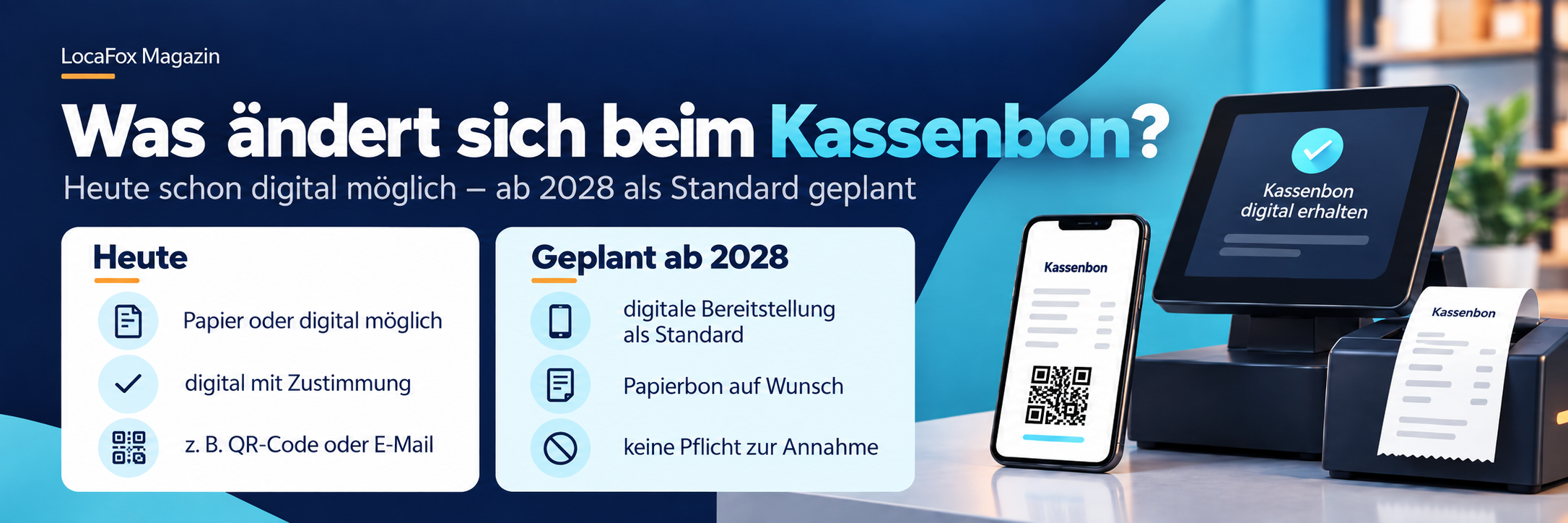
Digital receipts are already permitted. Under current law, a receipt may be issued in paper form or—with the recipient’s consent—electronically in a standardized data format. Providing an electronic receipt via a QR code and a download also satisfies the current requirement to issue receipts.
Starting January 1, 2028, this principle is set to change: According to the government’s draft bill, an electronic receipt must generally be provided. The customer is not required to actually access or accept this digital receipt.
At the same time, the federal government makes it clear that customers should still be able to receive a paper receipt upon explicit request. In the future, digital receipts will be the standard, and paper receipts will be the exception.
This issue therefore affects not only merchants who will need an electronic cash register for the first time in the future. Businesses that already use a TSE-compliant cash register should also assess how their cash register solution will be able to implement the planned electronic receipt provision in the future.
The planned requirement to use a cash register should not be confused with the existing regulations.
Anyone who currently uses an electronic point-of-sale system with the corresponding cash register functionality must comply with the applicable legal requirements. These include, in particular, securing the system with a certified TSE, as well as the legal requirements for record-keeping and receipt issuance. In addition, there is already a requirement to report electronic record-keeping systems to the tax authorities.
The new cash register requirement therefore does not mean that these regulations will not take effect until 2028. Rather, what is new is that certain businesses will in the future be required to use an appropriate electronic cash register system.
The government’s draft bill also provides for new sanctions. Among other things, violations of the requirement to provide electronic receipts, as well as the unauthorized failure to use a mandated electronic recording system with TSE, would be punishable as administrative offenses. In addition, the use or distribution of tampering software would be subject to stricter criminal penalties.
It is therefore important for merchants to check in a timely manner whether their point-of-sale system meets the legal requirements.
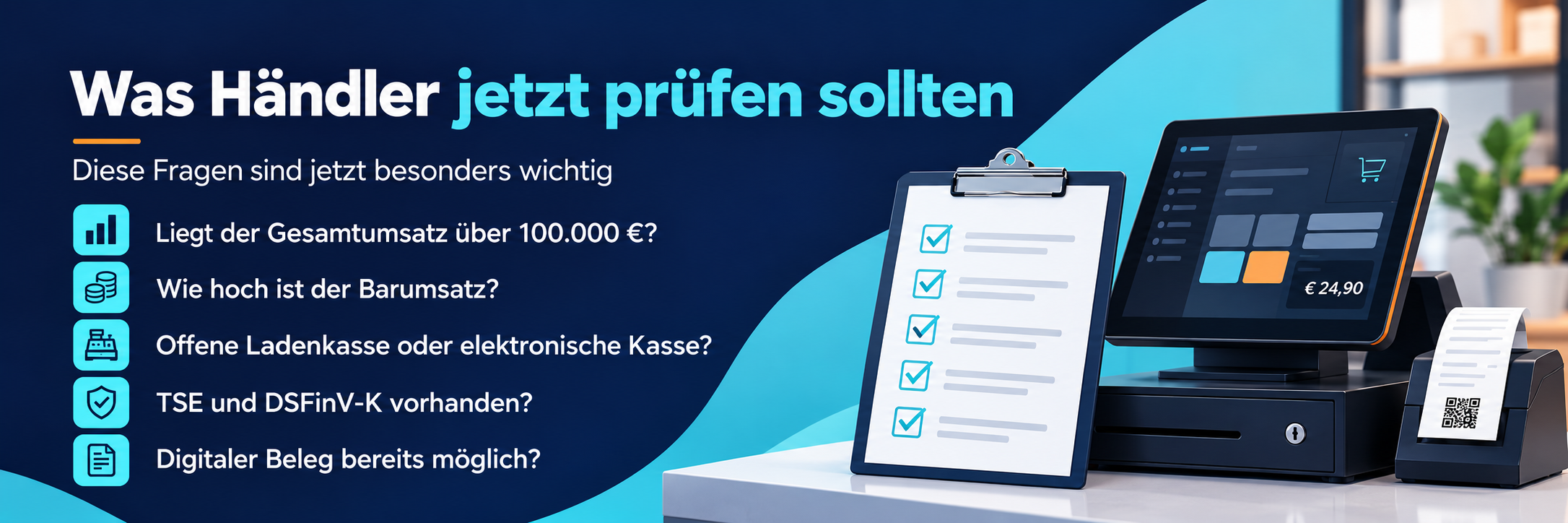
There is still no reason to replace hardware in the short term because of the proposed bill. However, businesses that have been using open cash registers up to now should assess their situation early on.
The following questions are particularly relevant:
This makes it possible to identify early on whether and when action might be needed.
Example 1: Retailer with an open cash register
A retailer will exceed the applicable total sales threshold as early as 2026 and generate significantly more than 12,000 euros in cash sales. Unless another exemption applies, the retailer would be required to use a compliant electronic cash register system starting January 1, 2028, according to the current government draft.
Example 2: High total sales, very little cash
A business generates more than 100,000 euros in total revenue but receives less than 12,000 euros in cash per year. Under the current government draft, the proposed exemption would apply, and the business would not be subject to the new cash register requirement solely on the basis of its total revenue.
As a provider of modern point-of-sale systems, LocaFox is constantly addressing the legal requirements related to cash register management, TSE, fiscalization, and tax data recording.
Our point-of-sale systems already meet the technical requirements that apply to electronic point-of-sale systems. At the same time, we are closely monitoring the ongoing legislative process surrounding the planned mandatory use of electronic point-of-sale systems and will adapt our solutions to meet any new legal requirements.
We are here to advise retailers who are still using an open cash register today or who are unsure whether their existing point-of-sale system will meet future requirements.
Would you like to prepare your point-of-sale system for the new requirements in a timely manner? Contact us—together, we’ll determine which solution is right for your business.
*Reviewed and updated on September 28, 2026. This article is based on the government bill adopted by the Federal Cabinet on September 23, 2026, and the most recent publications from the Federal Ministry of Finance. The legislative process has not yet been completed. Regulations, deadlines, and exceptions may still change before the bill is finally enacted.