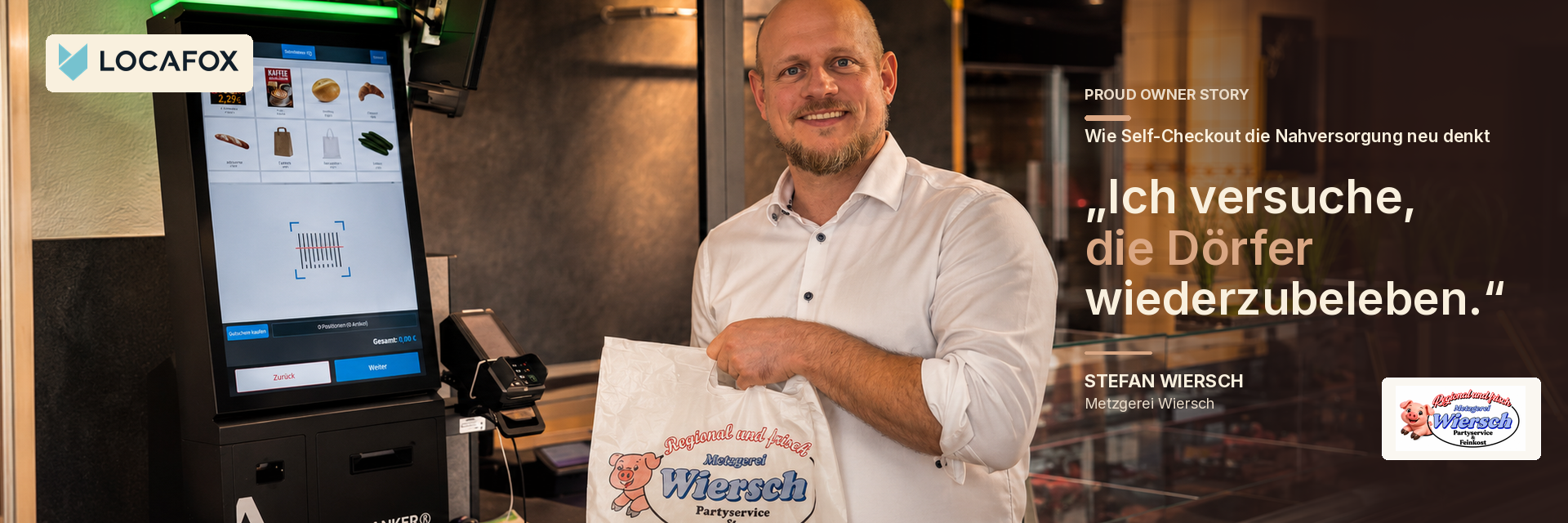
When the Wiersch butcher shop had to shorten its hours from 6 p.m. to 2 p.m., customers found the doors closed in the afternoon. For master butcher Stefan Wiersch, one thing was clear: A self-service store was no longer a distant vision of the future, but a necessity. Today, this third-generation family business combines traditional butchery with self-checkout, 24/7 sales, and its own digital applications—not because digitalization sounds modern, but because it solves a concrete problem. “I’m not digitizing Landkern and the surrounding area. I’m trying to revitalize the villages. And the tool for doing that is digitalization.”
Our simple and expandable POS system makes everyone happy: you, your customers, employees and the tax office - thanks to direct DATEV connection.
We visited Stefan Wiersch in Landkern and met an entrepreneur who wants to preserve tradition—and is, for that very reason, always willing to break new ground.
The transformation at Metzgerei Wiersch did not begin with a strategic digitalization project. It began with a very specific problem.
Within a short period of time, several employees were unable to work. The butcher shop had to reduce its hours from 6 p.m. to 2 p.m. The products were available, as was the demand—but there weren’t enough staff members to staff the shop in the afternoon.
For customers, this meant that anyone who wanted to shop later in the day found the store closed.
For Stefan, this situation was a turning point.
“We had reached a point where a self-service store was no longer an option, but a necessity.”
Suddenly, the key question became: How can we continue to deliver our products to customers without having to staff additional sales shifts?
Within four months, the first retail container was ordered, equipped, and opened. Instead of further restricting operating hours, technology was now expected to do exactly the opposite: increase availability.
Self-checkout did not become the sole solution—but it did become a crucial part of the answer.
Stefan sums up what he hopes to preserve with this change in a single sentence:
“To me, Wiersch Butcher Shop represents a piece of home, freshness, and flavor.”
The family-run business has deep roots in Landkern and the surrounding region. The meat comes from local farmers. Many of the sausages are made in-house, and the steaks are hand-cut and seasoned with the restaurant’s own spice blends.
In addition, there is salami, ham, various types of bratwurst, and nearly 40 different ready-to-eat meals.
And then there's the round meat sausage.
It has been a customer favorite for more than 50 years. According to Stefan, some regular customers even travel more than 50 kilometers just to buy it.
Craftsmanship, quality, and a connection to the region continue to form the foundation of the butcher shop. Nevertheless, the business looks very different today than it did just a few years ago.
“It used to be relatively simple,” says Stefan. “Nowadays, you have to reinvent yourself almost every year.”
The reason for this is not a lack of demand. It is the changing business environment: It is harder to find staff, traditional business hours are not economically viable everywhere, and business owners must juggle more and more tasks at the same time.
The idea of a self-checkout lane was by no means foreign to Stefan. As a tech-savvy entrepreneur, he had already used such systems while shopping at larger supermarkets.
He was much more concerned with another question: Why should this technology be available only to large retail chains?
"I thought it was a great idea that the small butcher or the small retailer next door could integrate such registers into their stores."
For Stefan, self-checkout is not meant to replace traditional sales. The technology complements it in situations where fixed hours of operation and a permanent staff are not feasible from an organizational or economic standpoint.
Or, as Stefan puts it:
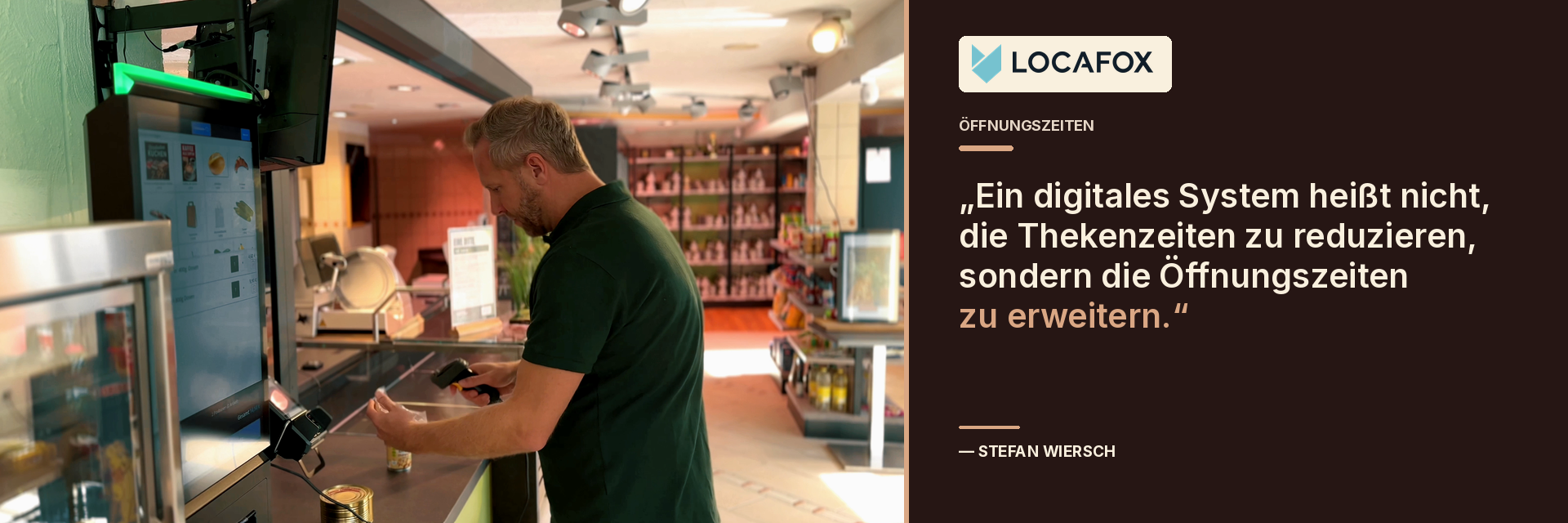
"A digital system doesn't mean reducing bar hours; it means extending operating hours."
At the traditional butcher's counter, customers still receive advice, have their meat sliced, and make purchases in person. Self-service stores offer additional options—for example, in the evening, on weekends, or at times when the main store is already closed.
Stefan equipped his first self-checkout location with a point-of-sale system from another provider. As a result, he already knew exactly what to look for in a new solution.
After comparing providers, he decided to go with LocaFox for his next store.
After the initial installation, he quickly realized:
"I'm staying right here!"
In some cases, only a few months passed between the opening of the first locations. The impetus for opening additional stores often came directly from the region. Friends and acquaintances brought vacant spaces to Stefan’s attention. People from nearby towns asked him if it would be possible to open a store like that in their area as well.
What began as a single self-service store gradually evolved into a concept for multiple locations.
But Stefan isn't expanding based solely on a hunch. Before opening a new store, he looks at the numbers.
In the back office, he compares sales figures, sales trends, and different time periods. He identifies which products are selling particularly well and how a location is performing over the course of weeks and months.
"When it comes to expansion, the numbers always have to add up. If the numbers don't add up, there's no point in continuing."
For Stefan, therefore, digitization isn't just about putting modern devices in a store. It also creates a better foundation for business decisions.
"I'm trying to revitalize the villages."
If you talk to Stefan about his various self-service locations, you might quickly get the impression that his main goal is to digitize his home region.
He himself would put it differently.
“I’m not digitizing Landkern and the surrounding area. I’m trying to revitalize the villages. And the tool I’m using to do that is digitization.”
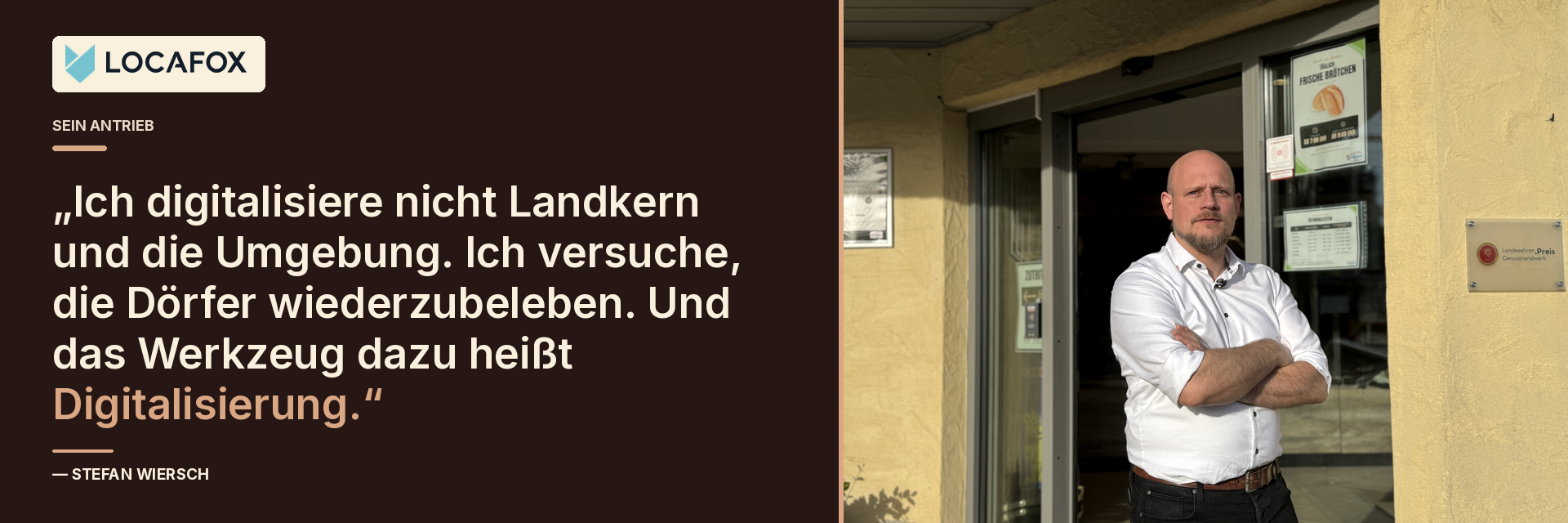
This sentence perhaps best describes what lies behind his concept.
After all, in many rural areas, local access to groceries is no longer a given. In some cases, people have to travel several kilometers to buy milk, eggs, or other everyday food items.
This can be a problem, especially for older people or those with limited mobility.
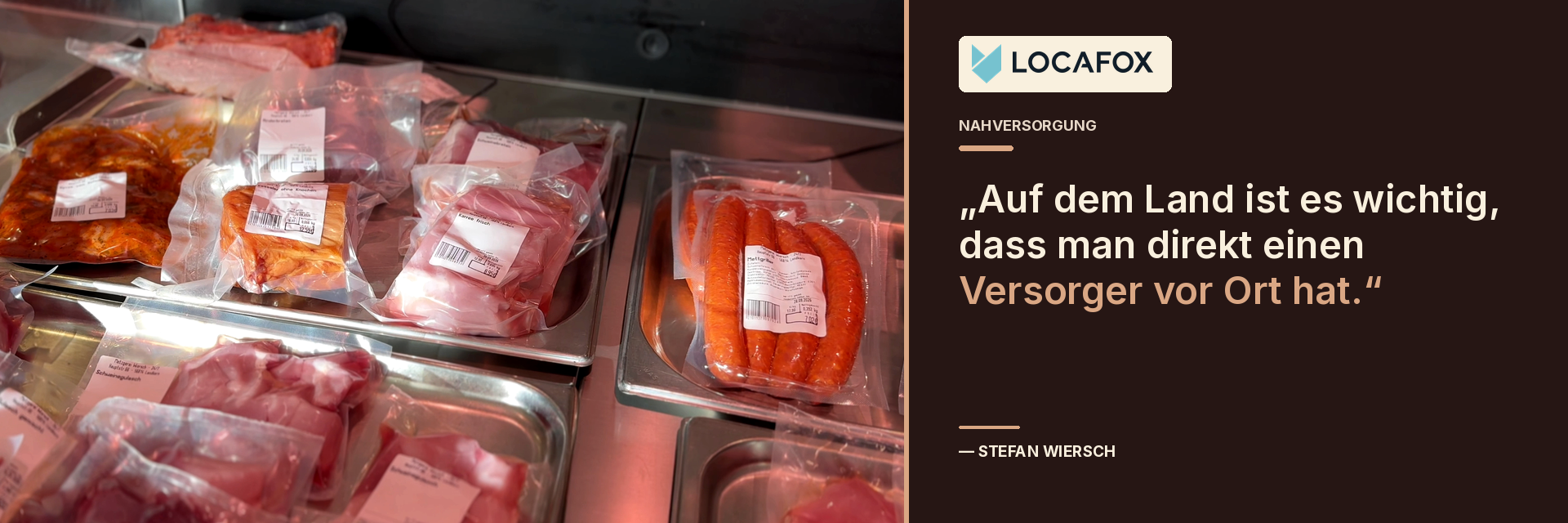
Stefan's self-service stores are therefore not meant to be merely additional retail outlets for meat and sausage. The product range has been deliberately expanded. In addition to the store's own butchery products, customers can also find eggs, canned goods, other groceries, and some non-food items for everyday needs.
And this is largely independent of traditional business hours.
"In rural areas, it's important to have a local utility provider right there."
Self-checkout is thus evolving from a mere point-of-sale system into a component of the local infrastructure.
For Stefan, it is his customers' reactions above all that show that the self-service system works.
Of course, there was some initial hesitation. Older people, in particular, sometimes had to be guided through the new process. Younger customers were often already familiar with self-checkout from supermarkets or other stores.
Stefan's experience: Once you understand the system, you'll usually have no trouble using it.
That's why user-friendliness is crucial. It should be possible to complete a purchase in just a few steps. No one wants to have to register first, create a detailed customer profile, or spend a long time figuring out which button to click next.
There was one advantage Stefan hadn't even expected at first: speed.
Many customers finish their shopping in just a few minutes.
"With us, you'll be back in your car in three or four minutes, get home faster, and have more time for yourself."
The stores are now frequented by people of all ages. Younger customers often come in the evenings and on weekends. During the day, Stefan sees older people who are happy to have a place to shop right in their neighborhood again.

There's one myth Stefan is determined to dispel: A self-service store doesn't run itself.
Goods must continue to be produced, packaged, and stocked. Inventory levels must be monitored, stock takings conducted, and sales areas cleaned. Purchasing, order fulfillment, and the distribution of products to the various locations also remain necessary.
“Many people think: ‘With self-checkout, I don’t have to do anything anymore.’ While working hours are reduced, they don’t disappear entirely. They just shift.”
However, it is precisely this shift that opens up new possibilities.
Certain tasks no longer need to be completed during an entire sales shift. For example, merchandise can be stocked in the morning or in the afternoon. This allows for more flexible work arrangements and makes individual tasks appealing even to people who cannot work a full shift behind the sales counter.
That is why self-checkout at Metzgerei Wiersch is not a tool for reducing staff.
"Self-checkout hasn't replaced any of our employees."
With the additional locations, even more has to be produced. More merchandise is packaged, purchased, picked, and distributed to the individual retail locations. This creates new tasks—just not necessarily behind a traditional sales counter.
For Stefan, that's a crucial difference.
In some locations, the alternative to unstaffed sales would not be an additional sales clerk. The alternative would be: no store at all.
"I definitely wouldn't be able to run my current retail locations if I had to have staff there all the time."
Sales at small local retail locations often do not allow for a permanent staff. At the same time, it is difficult to find suitable sales personnel.
His conclusion is therefore clear:
"Before we have to close the store, we'd rather offer a 24-hour store option with a self-checkout system."
At Metzgerei Wiersch, self-checkout is just one part of a larger trend.
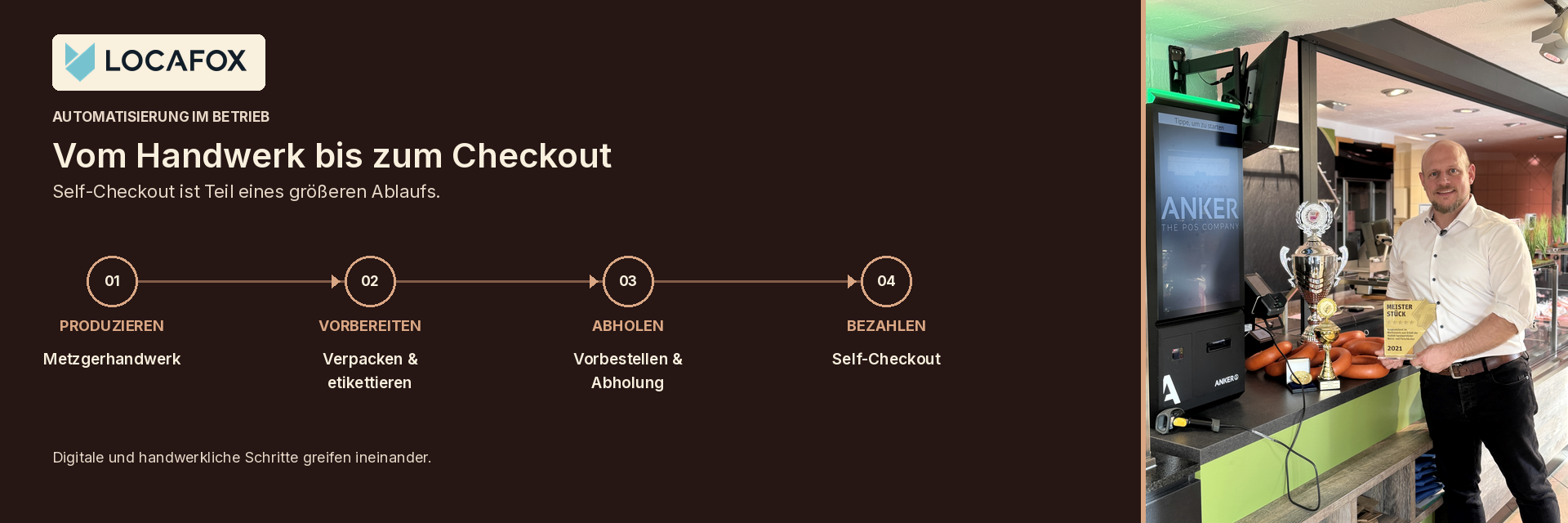
Many processes have now been automated or are digitally supported. A modern packaging machine makes it easier to prepare the goods. Customers can pre-order products, have cold cuts prepared, pick up their order later, and then pay on their own.
However, until these processes were up and running, the company had to make quite a few changes.
The shift from traditional counter service to self-service isn't simply a matter of placing the same products on a different shelf. Products must be vacuum-sealed and labeled. Nutritional information must be included, and each product requires a corresponding EAN code.
"It was precisely this amount of work that we underestimated at the beginning," Stefan explains.
For him, this is also part of an honest assessment of self-checkout: The technology simplifies many procedures, but it requires that the surrounding processes be well organized.
If this works, the individual steps will flow together more and more smoothly—from preparation and packaging to pickup and payment.
"Automation allows us to speed up and simplify all of our processes."
For Stefan, that is where the true value of modern technology lies: it should not create additional processes, but rather integrate existing workflows in a meaningful way.
Based on his experience with a previous point-of-sale system, Stefan knew pretty much exactly what was important to him when choosing a new solution.
At the top of his list was user-friendliness—both for him and his employees, as well as for the people who would later be paying at the register on their own.
Product management also played an important role. New items must be added regularly, prices updated, and data maintained. In the previous system, this process was unnecessarily time-consuming for Stefan. With LocaFox, he found product management to be significantly faster.
Another important point was personal contact.
Even before he made his decision, he was shown the various functions, given a tour of the back office, and had his questions answered.
"I was already familiar with the system before I bought it. That was incredibly important to me."
Today, Stefan uses both self-checkout registers and a traditional staffed register from LocaFox. It is precisely this combination that is crucial for him.
Instead of maintaining different systems, databases, and reports in parallel, the information is consolidated in a single back office. This also makes it easier to set up additional locations.
Once the merchant account has been set up, there is no need to completely recreate products and master data when adding an additional LocaFox register.
For an entrepreneur who has set up multiple retail locations in a short period of time, this scalability is particularly important.
After all, digitization is meant to facilitate growth—not to create additional administrative work with every new location.
Anyone who gets to know Stefan a little better quickly realizes that simply using off-the-shelf technology isn't always enough for him.
Before becoming a master butcher, he trained as an electrician. That technical curiosity has stayed with him.
"When I hear, 'That doesn't work,' I don't look for where I can buy it. Instead, I think, 'How can I build it myself?'"
That's why Stefan now also uses LocaFox's open API and develops his own applications for his day-to-day business operations.
For example, he developed a solution that displays important information directly on his smartphone. This means he doesn't have to open the full back office every time to check on specific processes.
An AI-powered answering machine takes this a step further. It is designed to automatically provide customers with information about which products are currently available and which may already be sold out.
This means Stefan doesn't have to answer the phone in person around the clock. At the same time, the technology can keep him informed about what's happening at his stores. He then decides whether someone actually needs to go to the location or take action on site.
So at Metzgerei Wiersch, automation doesn't stop at the register.
It is becoming increasingly prevalent throughout the entire business—from packaging to sales to customer communication.
The more a business is automated, the more important the reliability of the systems used becomes.
If the central cash register goes down in an unstaffed store, in the worst-case scenario, no one will be able to pay. That’s why, for Stefan, the availability of support is just as crucial as the technology itself.
He realized just how important that can be shortly before the opening of his new store in Düngenheim.
Three days before the scheduled launch, the hardware failed. Within two days, a replacement system was prepared and set up. As a result, the store was able to open as planned.
Since then, Stefan reports, the system has been running without a hitch.
The situation made it clear to him once again: When it comes to an automated facility, it’s not just about the features a system offers on paper. What’s also crucial is how quickly a solution can be found in an emergency.
At Metzgerei Wiersch, steaks are still cut by hand. Sausages and ham are made in-house. The meat comes from the region.
Technology replaces neither the butcher's craft nor the personal connection with customers.
The ways in which products reach their customers have changed.
Self-checkout, 24/7 sales, automated processes, digital analytics, and custom applications are helping Stefan keep his business running under these new conditions.
Self-checkout has thus long since become more than just a checkout solution. The technology has become a cornerstone of a new business model—one that extends the availability of regional products, makes smaller locations economically viable, and brings local grocery shopping back to areas where it had, in some cases, already disappeared.
Don't digitize just because "digitization" sounds modern.
Instead, use technology where it solves a specific problem.
At the time of our visit, Stefan had opened four new locations within a year and had many long workdays behind him. Now, his first priority is to ensure that all processes are running smoothly.
And then, he says with a laugh, what he wants most of all is some peace and quiet. Maybe, at some point, a normal eight-hour day again instead of twelve.
Still, he wouldn't regret the path he's chosen.
"I'd do it again in a heartbeat."