Point-of-sale systems in 2026: TSE requirement, reporting obligation, and VAT at a glance

The year 2026 will bring noticeable changes in the POS environment for retailers, restaurateurs, and service providers. Legal requirements will be monitored more consistently, transition periods will expire, and tax adjustments will require technical and organizational preparation. At the same time, opportunities for more efficient processes and greater planning security will arise—provided that the POS system used is flexible and future-proof. This article provides a structured overview of the most important changes in 2026 and shows why retailers are well positioned with a modern POS system such as LocaFox.

Our simple and expandable POS system makes everyone happy: you, your customers, employees and the tax office - thanks to direct DATEV connection.

Date
September 3, 2026
Author

1. KassenSichV remains central – controls become more specific

The Cash Register Security Regulation (KassenSichV) will remain the authoritative set of rules for electronic cash register systems in Germany in 2026. Its aim is to ensure that tax-relevant data cannot be manipulated. While the basic requirements have been in place for several years, one thing in particular will become apparent in 2026: the tax authorities will conduct fewer formal checks and instead focus on practical aspects.

For retailers, this means:

  • Electronic cash register systems must be operated permanently with a certified technical security device (TSE). You can find more information about obligations, deadlines, and approved systems in our magazine article on Technical Security Device for Electronic Cash Registers.
  • All business transactions must be recorded completely, unalterably, and traceably.
  • Data export in the standardized DSFinV-K format must function reliably in the event of an audit.
  • Cash register systems must be correctly registered with the tax office—as we already explained in our article on reporting requirements for electronic cash register systems .

It is particularly relevant that these requirements apply not only to traditional cash registers, but also to self-checkout systems, mobile POS solutions, and hybrid cash register models.

2. TSE requirement 2026: Transition periods come to a definitive end

A key issue in 2026 will be the end of the final transitional arrangements for the TSE requirement. This will be particularly evident in the taxi and rental car industry: from January 1, 2026, taximeters and odometers may only be operated if they are equipped with a certified TSE. Devices without the appropriate security features will then no longer be permitted.

But even beyond the transport industry, the following applies:

  • Retailers and restaurants must ensure that their POS systems not only technically comply with TSE requirements, but that these requirements are correctly integrated.
  • Mobile cash registers and self-checkout terminals are also considered electronic recording systems within the meaning of the KassenSichV.
  • Special attention is paid to special cases such as cancellations, interruptions, training bookings, or mixed sales.

In practice, it often turns out that having a TSE in place does not automatically mean that the system is also being used in an audit-proof manner. This is precisely where risks arise in 2026.

If you would like to prepare specifically for possible audits, our magazine offers an article on Cash register inspection – What is it and how can I prepare for it? provides valuable guidance.

3. Reporting requirements for cash registers remain a critical issue

Since January 1, 2025, electronic cash register systems must be reported to the tax office. This obligation will remain relevant in 2026, as it is increasingly becoming the basis for cash register inspections and tax audits.

Important for retailers:

  • New cash register systems must be reported within one month of being put into operation.
  • Appropriate updates are required in the event of system changes or decommissioning.
  • Incorrect or missing reports can lead to objections in the event of an audit, regardless of whether the cash register is working correctly from a technical standpoint.

A structured POS system not only facilitates data provision, but also reduces organizational effort.

4. Value added tax in the restaurant industry: Return to 7% on food from 2026

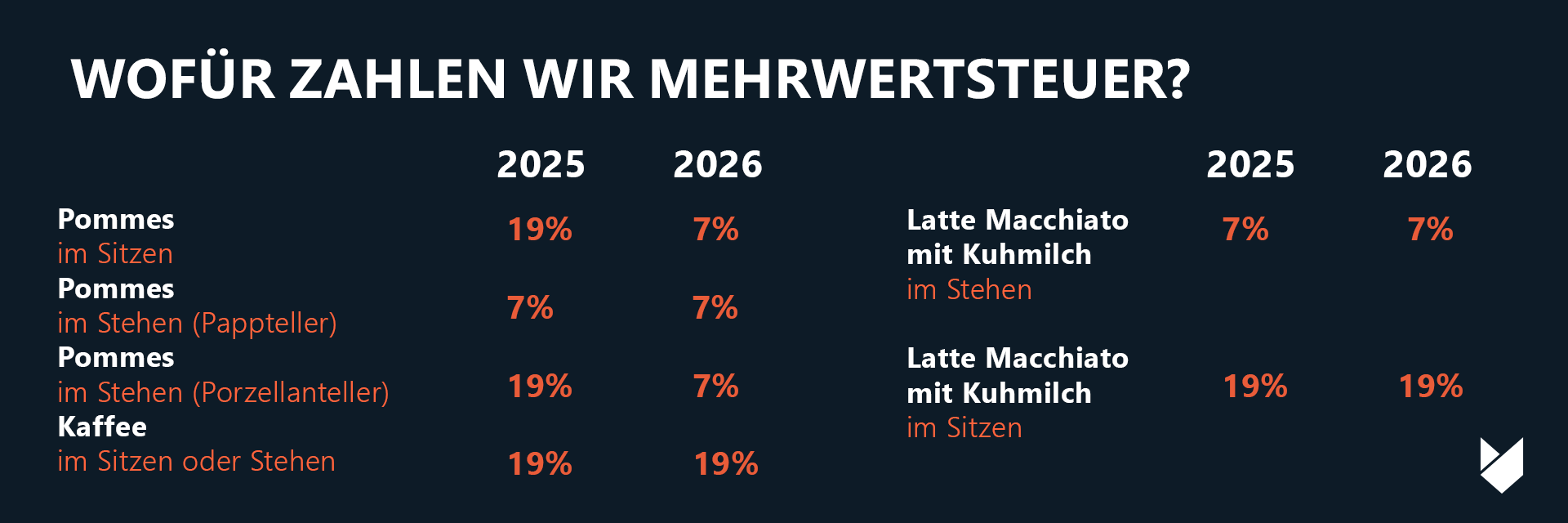
In addition to compliance-related issues, 2026 will also bring a tax change that will have a significant practical impact on restaurateurs: From January 1, 2026, the reduced VAT rate of 7% will once again apply permanently to food in restaurants. Beverages will continue to be subject to the regular tax rate of 19%.

For many businesses, this regulation means:

  • A noticeable tax relief on food sales
  • More leeway in pricing, margin stabilization, or investments
  • At the same time, there were increased requirements for the correct mapping of different tax rates in the POS system.

A clear separation of tax rates is crucial, especially in businesses with mixed sales, menu offerings, or to-go and on-site sales.
5. Challenges in practical implementation

The change in value-added tax is not purely an accounting issue. It directly affects day-to-day operations:

  • Products and product groups must be correctly stored with the new tax rate.
  • The time of performance is crucial, especially around the turn of the year.
  • Invoices and receipts must be correctly reported for tax purposes.
  • Combinations of food and beverages must be billed separately.

Without a flexible POS system, this transition can be error-prone and time-consuming.

6. Why retailers are well positioned with LocaFox 2026

In 2026, a modern POS system will have to do more than just process payments. LocaFox supports retailers and restaurateurs precisely where new legal and organizational requirements arise—and takes a large part of the complexity off their hands.

  • Flexible VAT management:
    Tax rates can be adjusted easily and transparently—both for individual items and for entire product groups. The change to 7% for food can be implemented without technical hurdles and without major system interventions.
  • TSE-compliant architecture:
    LocaFox is designed for clean TSE integration and ensures complete, audit-proof recording of all transactions—including special cases such as cancellations or interruptions.
  • Digital registration of the cash register system via LocaFox:
    A particular advantage for retailers is the option to register the digital cash register system directly via LocaFox. Registration with the tax office is structured, guided, and significantly less complicated than if it had to be done independently. This saves time, reduces sources of error, and provides additional security in complying with reporting requirements.
  • Clear data structure and exportability:
    Exports for DSFinV-K, cash register audits, or tax audits are possible at any time and logically structured. Relevant data is available in a structured format without the need for time-consuming rework.
  • Uniform logic for all sales channels:
    Whether staffed checkout, self-checkout, or mobile POS—all sales follow the same compliant system. This not only simplifies audits, but also internal processes and evaluations.

This not only reduces the risk of tax audits, but also significantly reduces the administrative burden in day-to-day business. Retailers can concentrate on their core business, while LocaFox reliably handles the technical and formal requirements in the background.

Conclusion: Prepared for 2026 instead of surprised

The year 2026 marks an important milestone for the POS sector:

  • The requirements of the KassenSichV (Cash Register Security Regulation) are being implemented more consistently.
  • The TSE requirement applies without any further transition periods.
  • Reporting requirements are becoming increasingly important.
  • The change in value-added tax in the restaurant industry requires technical flexibility.

For retailers and restaurateurs, this does not necessarily mean more complexity—provided that the POS system is designed for it. With LocaFox, legal requirements, tax adjustments, and modern sales concepts can be mapped securely and easily. This means that 2026 will not be a risk, but rather a year with clear, easily manageable framework conditions.

Find out now and check whether your POS system is optimally positioned for 2026.

Sources

Contact us now and get free advice!

Contact us now and get free advice!

Up Arrow